
DESIGNING AN INFLATABLE HANGAR FOR REPAIR NEEDS AND CHALLENGING CLIMATES
1. The Problem
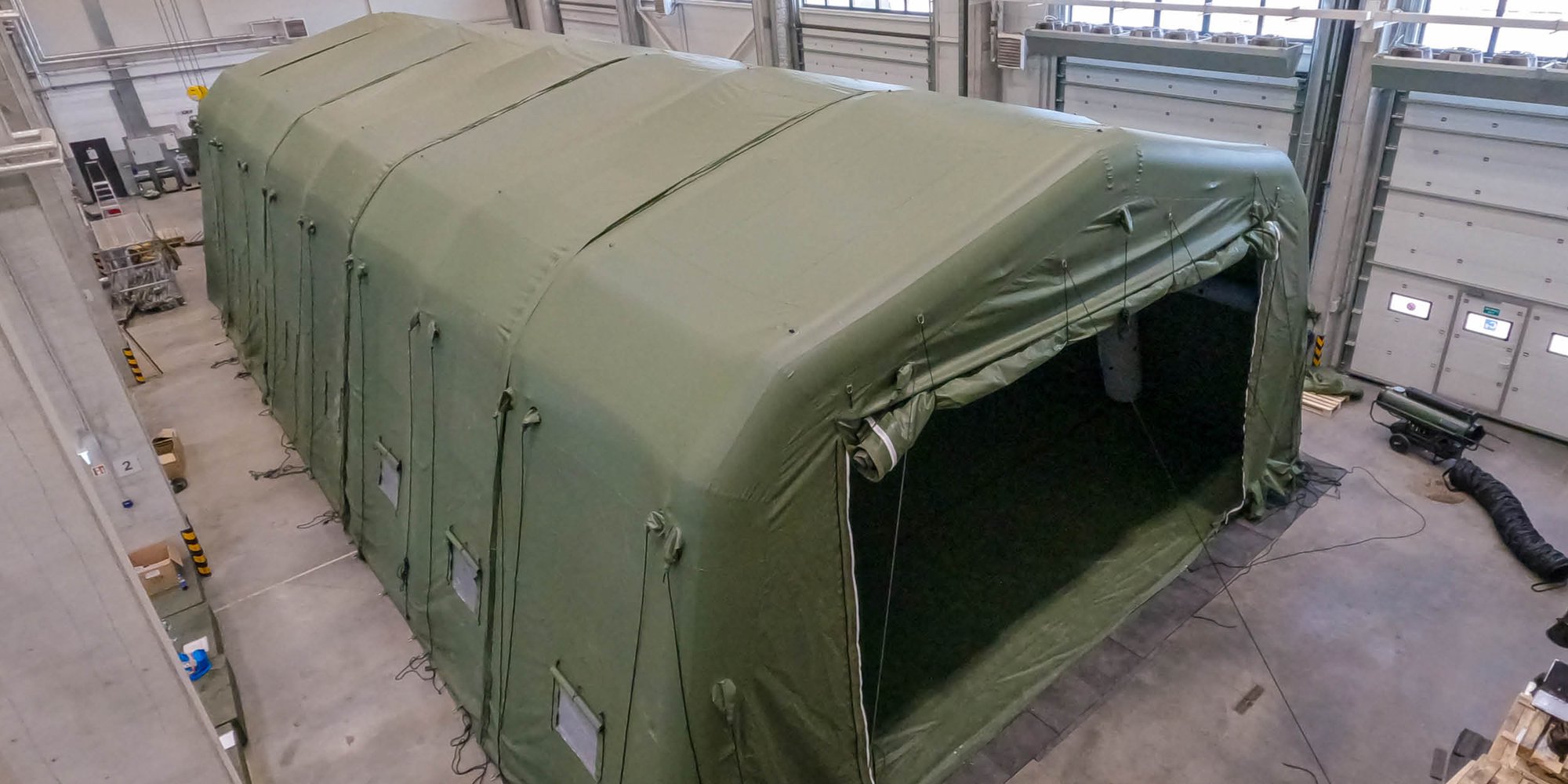
The customer required a large repair tent that could be easily relocated and deployed. The tent needed to be modular, low-maintenance, adaptable to different climates, and provide sufficient space for their operations. Specific temperature requirements were also clearly specified, with the tent needing to maintain +16°C in cold conditions (-30°C external temperature) and +22°C in hot conditions (+40°C external temperature).
2. The Challenge
The challenge was to design and deliver an inflatable hangar repair tent that met the customer's needs and technical specifications. The tent had to be composed of a pneumatic structure and a covering sheet, and it needed to be easily assembled and dismantled by trained operators. The tent also had to withstand challenging climates, be waterproof, and offer easy replacement of components subject to wear or damage.
The tent and its equipment were designed to withstand various challenging conditions, including heavy rain up to 1000 mm/m², a snow load of 25 kg/m², wind gusts up to 80 km/h, and air temperatures ranging from -30°C to +40°C. These specifications ensure that the tent remains undamaged and functional even in extreme weather conditions.
3. The Approach
The production, technical, and purchasing departments collaborated to analyze the customer's requirements and develop the best approach. They selected AZM low-pressure inflatable tents, which were known for their stability, generous interior volume, and high transportability.
Inflatable tents offer a reduced weight when compared to metal frame structures of similar size and performance. This advantageous feature simplifies transportation and deployment. Additionally, inflatable tents boast a low maintenance level, requiring minimal upkeep over time. The tents’ easy assembly and dismantling procedures contribute to its user-friendly nature. It can be swiftly set up and taken down as needed. Furthermore, its portability is enhanced, allowing for convenient movement both when packed and when fully assembled.

Thanks to the utilization of water-repellent materials, as well as the high-frequency welding assembly technique (HFW), inflatable tents exhibit a high level of waterproofness. Critical areas such as windows and doors have been specially addressed to ensure effective protection against water infiltration.
Furthermore, the inflatable tent allows for swift component replacement in the event of wear and tear or damage, without necessitating intervention from the manufacturer. This aspect enhances convenience and reduces downtime.
4. The Result
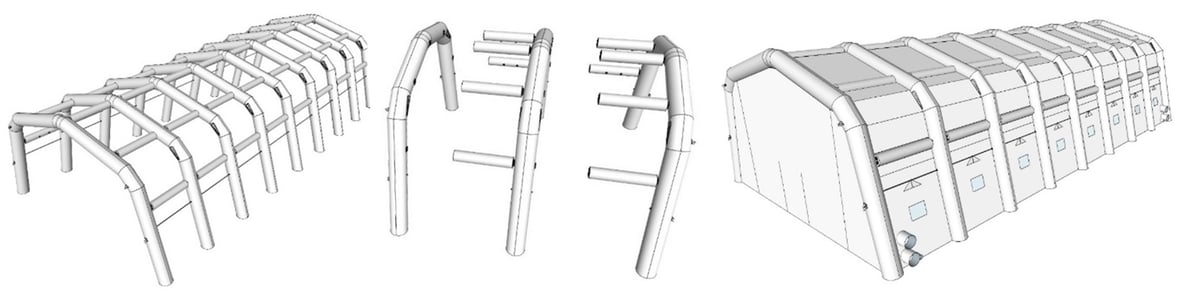
The supporting structure of the tent is constructed entirely using pneumatic elements, with inflation occurring through valves positioned on the same side near the base of the arches.
The bearing structure of the tent consists of pneumatic arches divided into five sectors, forming a gable roof shape. These arches are interconnected by three tubular inflatable spacers located along the roof's ridge and just above the gutter lines.
Each arch operates independently from the others, ensuring that the failure of one arch does not result in the collapse of the entire structure. With a diameter of 60 cm, each arch is composed of seven tubular sections made of polyester fabric coated on both sides with PVC, which are welded together.
To enhance thermal insulation and improve comfort, the inflatable hangar is equipped with an inner insulation liner. This liner consists of multiple sections made from fire-retardant fabric with excellent thermal insulation properties. Importantly, the fabric material does not absorb grease, oils, or other liquids, making it easy to wash and maintain cleanliness. The insulation liner plays a crucial role in reducing energy consumption by helping to maintain ideal temperatures inside the tent in accordance with external climatic conditions.
Three electric inflators and the necessary spiders were supplied with the inflatable hangar's inflation system. Inflation and deflation can be easily performed by inserting the simultaneous inflation kit into the couplings located on the sides of the inflators, which are equipped with simple pressure joints. The simultaneous inflation system consists of three branches made of polyurethane with an inner diameter of 20 mm. These branches are connected to a quick connector for insertion into the inflator vents.
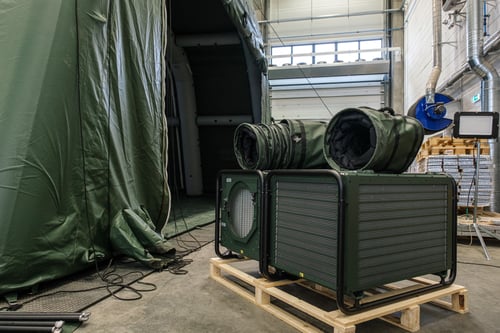
Heating, ventilation, and air conditioning equipment have been fully provided with the necessary accessories for operation. The sets of heating, ventilation, and air conditioning equipment included all the required flexible pipes (hoses) for the supply of warm and cold air to the tent. These pipes were insulated, and connectors were provided to ensure reliable connections between the heating, ventilation, and air conditioning equipment and the openings of the tent. All the equipment was designed to operate outside the tent without any difficulties.
The hangar successfully fulfilled the customers' requirements by offering key features such as the ability to relocate, adaptability to various climatic conditions, low maintenance requirements, and efficient utilization of space.
The successful delivery and use of the inflatable hangar repair tent strengthened the partnership we have with this customer. The versatility, cost-efficiency, and mobility of inflatable hangars make them essential, especially in military contexts where adaptability and mobility are crucial factors.